CERN · The Large Hadron Collider · 2012

Discovering the
Higgs Boson

“Am I responsible for the Higgs boson? Yep — it's my fault!”

The most famous discovery in modern physics needed thousands of tiny, perfect crystals to see it. A mechanical designer from Oxfordshire figured out how to build them. This is that story, told simply.

Start here ↓

The ATLAS detector at CERN's Large Hadron Collider · © CERN

On 4 July 2012, scientists at CERN announced they had found the Higgs boson — the last missing piece of our best theory of how the universe works. It made headlines around the world. Almost none of those headlines mentioned that part of the machine that saw it was designed by a man who came home from the lab at five o'clock every day.

That man was Brian Smith. To understand what he did, it helps to understand — gently, without any equations — what everyone was actually looking for, and why it took the biggest machine ever built to find it.

This page is written for family and curious readers. The underlined “from the archive” links open Brian's own documents. No physics background needed.

01

What is the Higgs boson?

Everything around you is made of tiny particles. For decades, physicists had a remarkably successful theory — the Standard Model — that described all the known particles and the forces between them. It worked beautifully, with one nagging problem: it couldn't explain why some particles have mass (why they're heavy) while others, like the particles of light, have none.

In the 1960s, several physicists — including Peter Higgs, and the trio Tom Kibble, Carl Hagen and Gerald Guralnik — proposed an answer. Imagine the entire universe is filled with an invisible substance, like a field of treacle. Some particles push through it easily and stay light. Others drag through it and feel heavy. That invisible field became known as the Higgs field.

Here's the catch. If that field really exists, then giving it a sharp enough "flick" should make it wobble — and that wobble would show up as a brand-new particle: the Higgs boson. Find the particle, and you've proved the field is real. For nearly fifty years, nobody could.
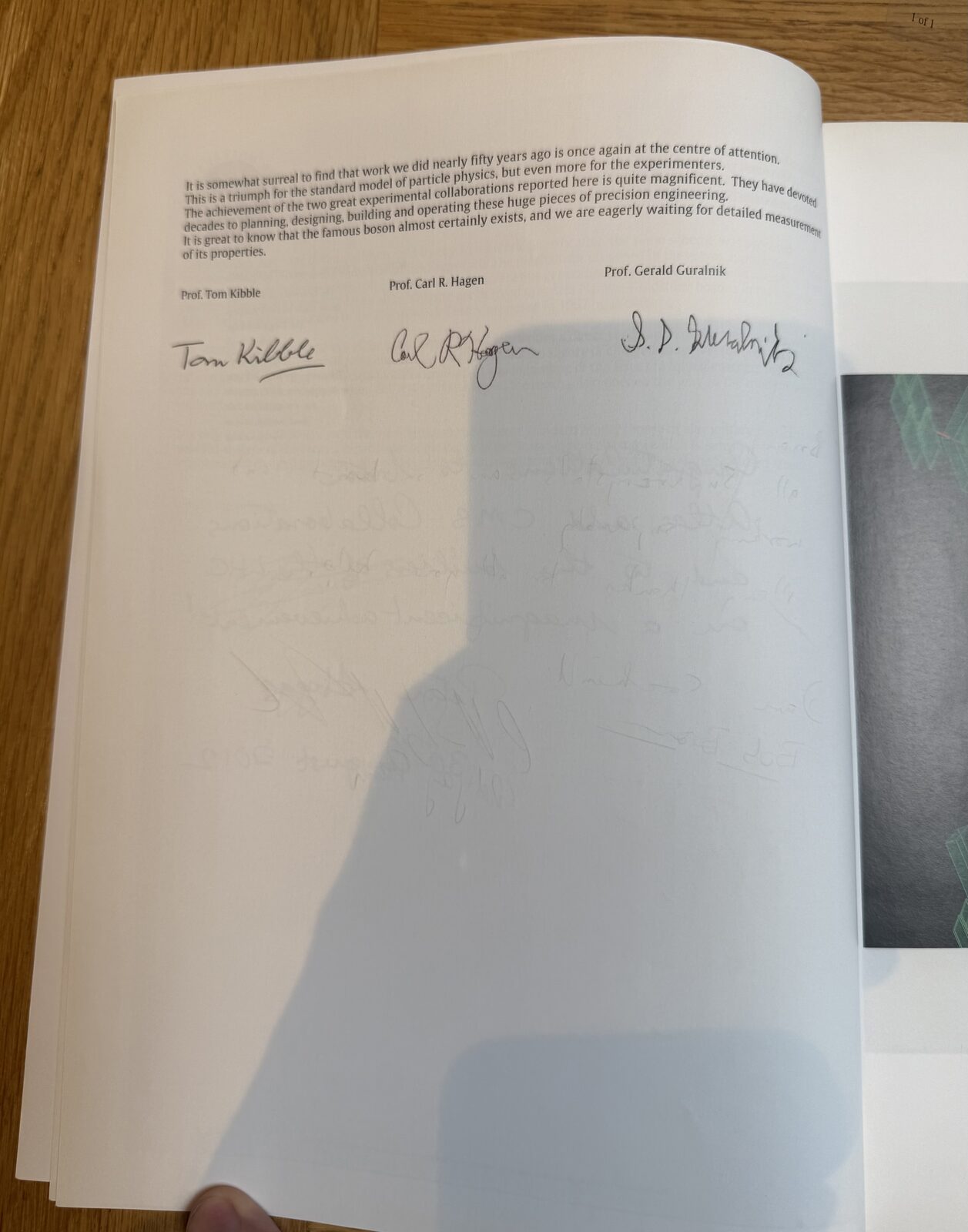
Theorists associated with the Higgs mechanism
Kibble, Hagen and Guralnik — among the theorists who, in 1964, proposed the mechanism behind the Higgs field. A print kept in Brian's archive.
02

Why build a 27-kilometre machine?

To "flick" the Higgs field hard enough, you need an enormous amount of energy packed into a tiny space — far more than exists anywhere on Earth naturally. So physicists built a machine to create it: the Large Hadron Collider, or LHC, at CERN on the French–Swiss border near Geneva.

The LHC is a ring 27 kilometres around, buried about a hundred metres underground. It takes protons — the cores of hydrogen atoms — and accelerates them to 99.9999% of the speed of light, in both directions, then crashes them head-on. In that violent collision, the energy briefly concentrates enough to create new, heavy particles that flash into existence and vanish in a fraction of a fraction of a second.

Most of those collisions produce nothing unusual. But just occasionally — perhaps once in billions — the conditions are right to make a Higgs boson. The problem is that the Higgs vanishes almost instantly, long before any instrument can touch it. You never see it directly. You can only catch what it turns into.

Aerial view of CERN
The landscape above CERN, where the 27-km LHC ring runs underground. © CERN, CC BY-SA
03

Why the crystals are the key

Catching what the Higgs leaves behind

When a Higgs boson dies, one of the ways it can decay is into two photons — two particles of very high-energy light, flying out in opposite directions. If you can catch those two photons and measure their energy and direction with extreme precision, you can work backwards and prove a Higgs was there. This was one of the main ways CERN hoped to find it.

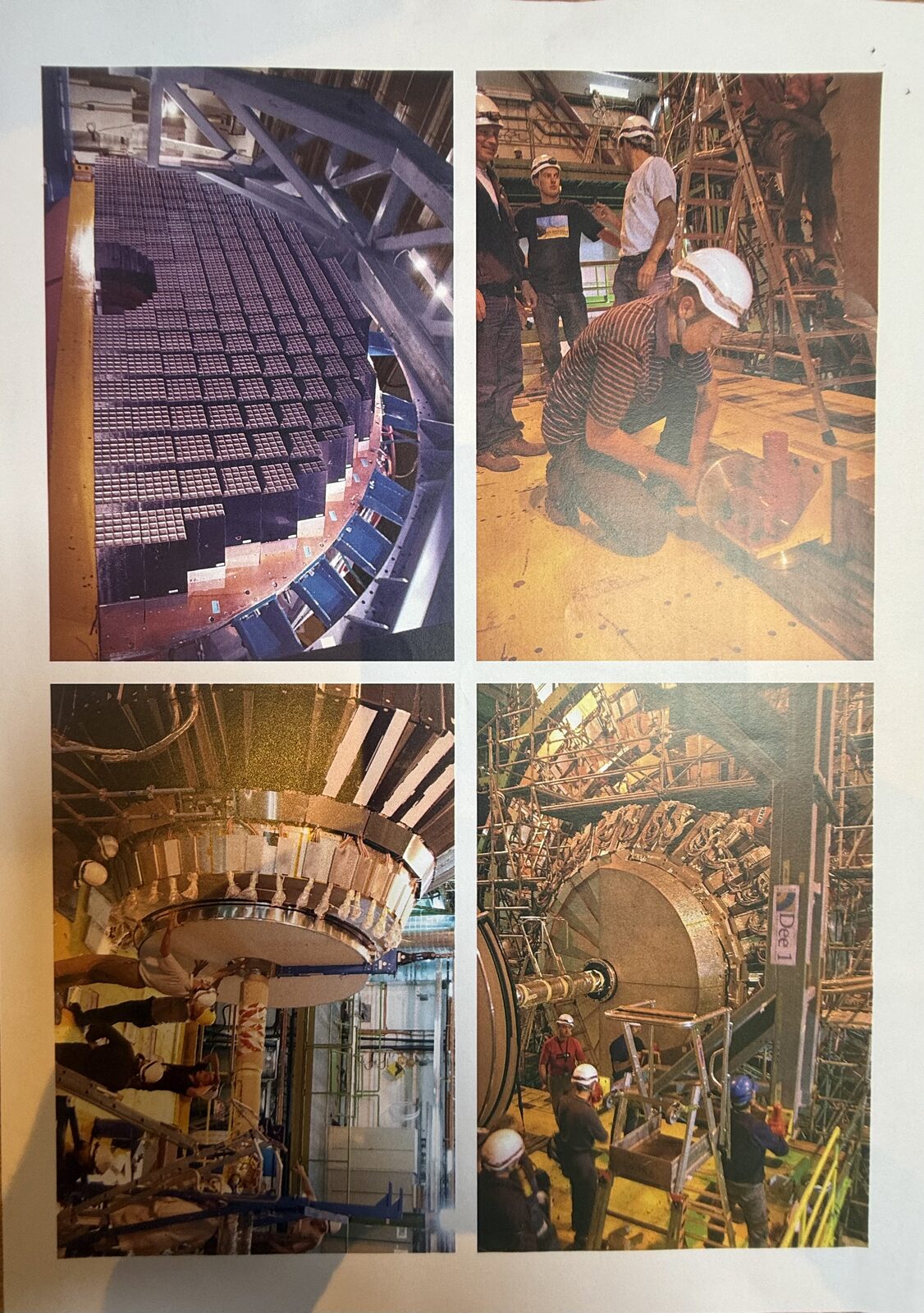
To catch those photons, the CMS detector — one of two giant detectors on the ring — uses an electromagnetic calorimeter, or ECAL: a wall built from roughly 75,000 dense, transparent crystals of lead tungstate. When a high-energy photon strikes a crystal, the crystal flashes with a tiny pulse of light. Sensors on the back of each crystal measure that flash. Map the flashes across thousands of crystals and you can reconstruct, precisely, the photons that caused them.

For this to work, the crystals have to be held in exactly the right position, packed as tightly as possible, with almost no gaps — because a photon that slips through a gap is a photon you've lost. Building a wall of 75,000 crystals to that precision, cheaply and reliably, was a brutal engineering problem. That is where Brian came in.

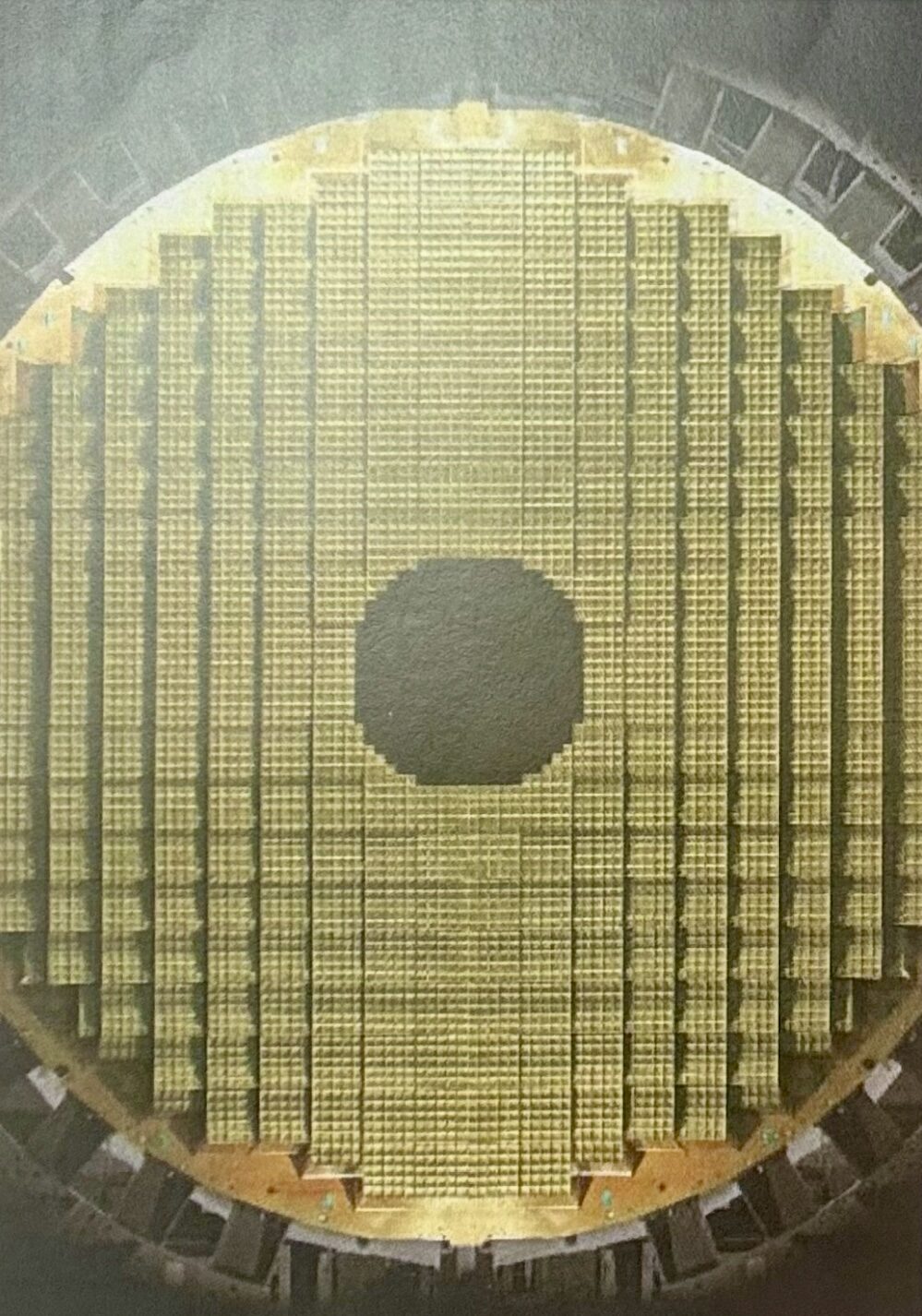
The ECAL end cap — a disc packed with crystals
One ECAL end cap: a disc packed with thousands of lead-tungstate crystals, each ready to flash when a photon hits.
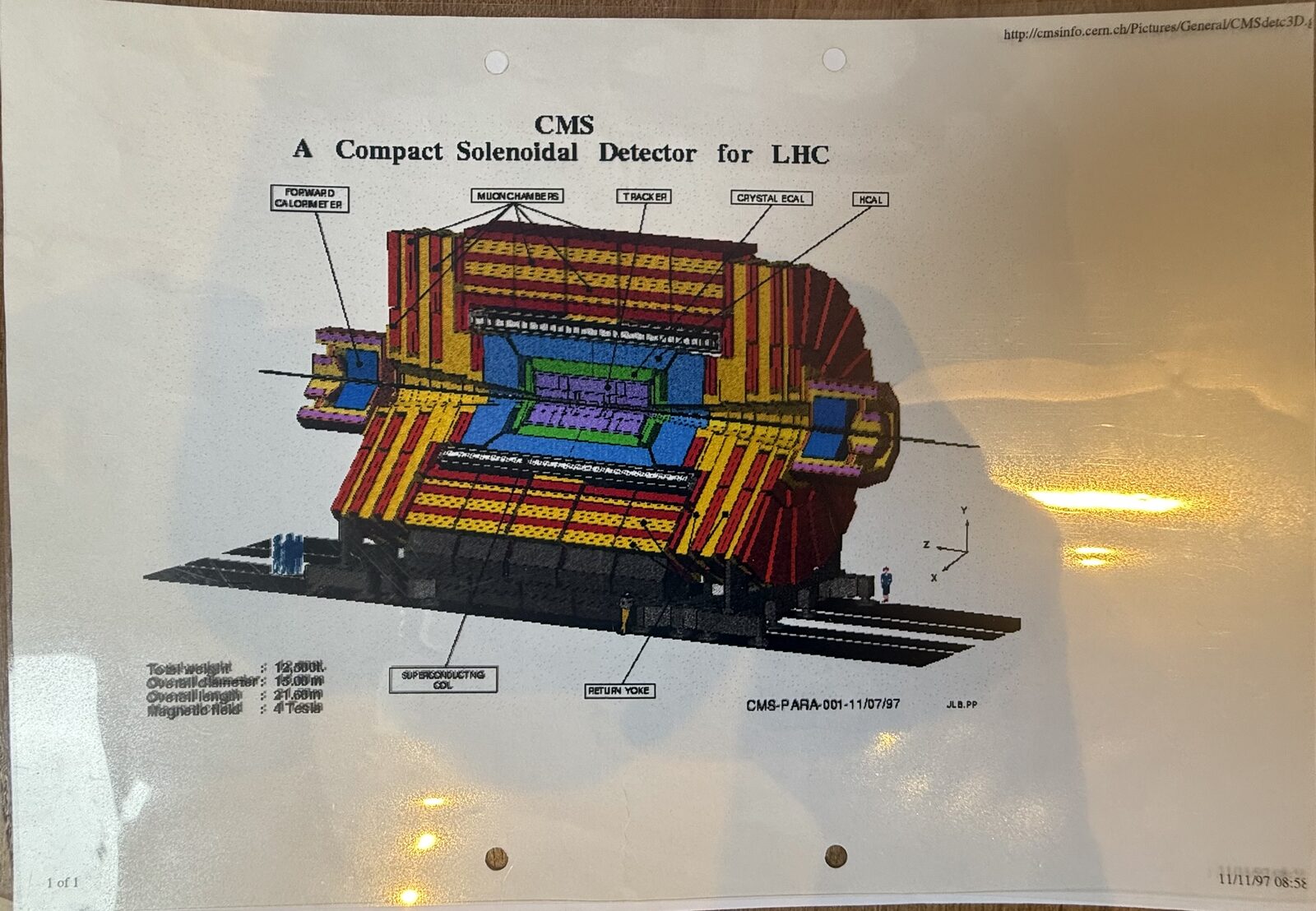
Cross-section of the CMS detector
CMS in cross-section — the crystal calorimeter sits in a ring around the collision point.
Diagram of the CMS detector
How the Compact Muon Solenoid is built up in layers.
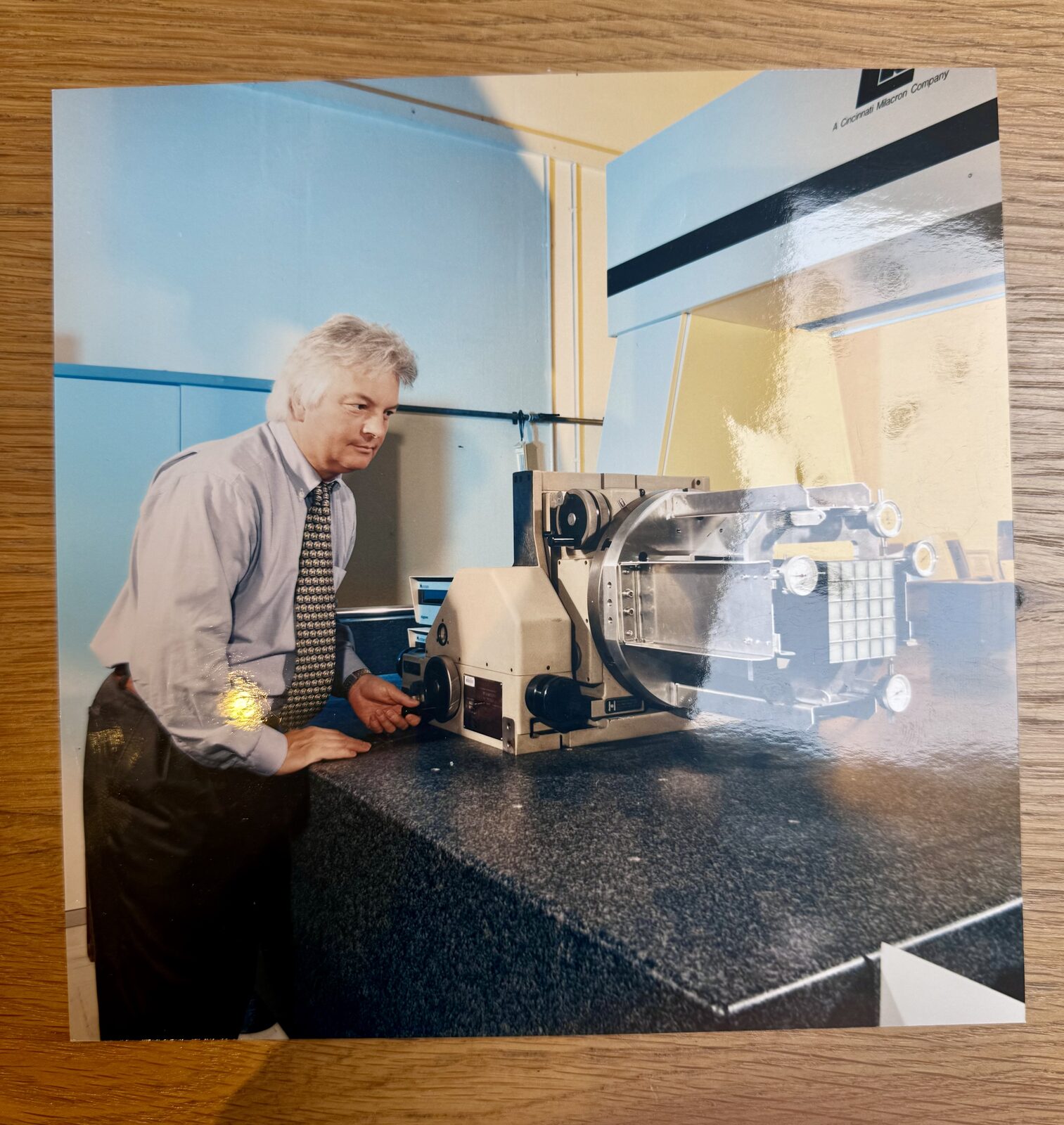
Brian handling a crystal sub-assembly
Brian handling a crystal sub-assembly at Rutherford.
04

Brian's breakthrough

Make every crystal the same

The crystals don't just sit loose. Each one lives in a thin-walled pocket called an alveola that holds it in place. The two end caps — the discs that close off each end of the calorimeter — were the hardest part, and the project had stalled. A team in Switzerland had designed them so that every crystal was a slightly different shape. That meant every alveola had to be different too, each needing its own custom mould. Tens of thousands of unique parts. It was elegant, and it was financially impossible.

Brian's team at Rutherford took the problem on, and Brian got the job of cracking it. His first attempt used seven different pocket sizes. Still too many. He kept iterating, trading a tiny increase in the gaps between crystals for far simpler manufacturing. Then he walked into a meeting and said:

“All the crystals are the same. And all the alveoli are the same. You could put any crystal in any alveola pocket, and any alveola in any position on the end cap.”

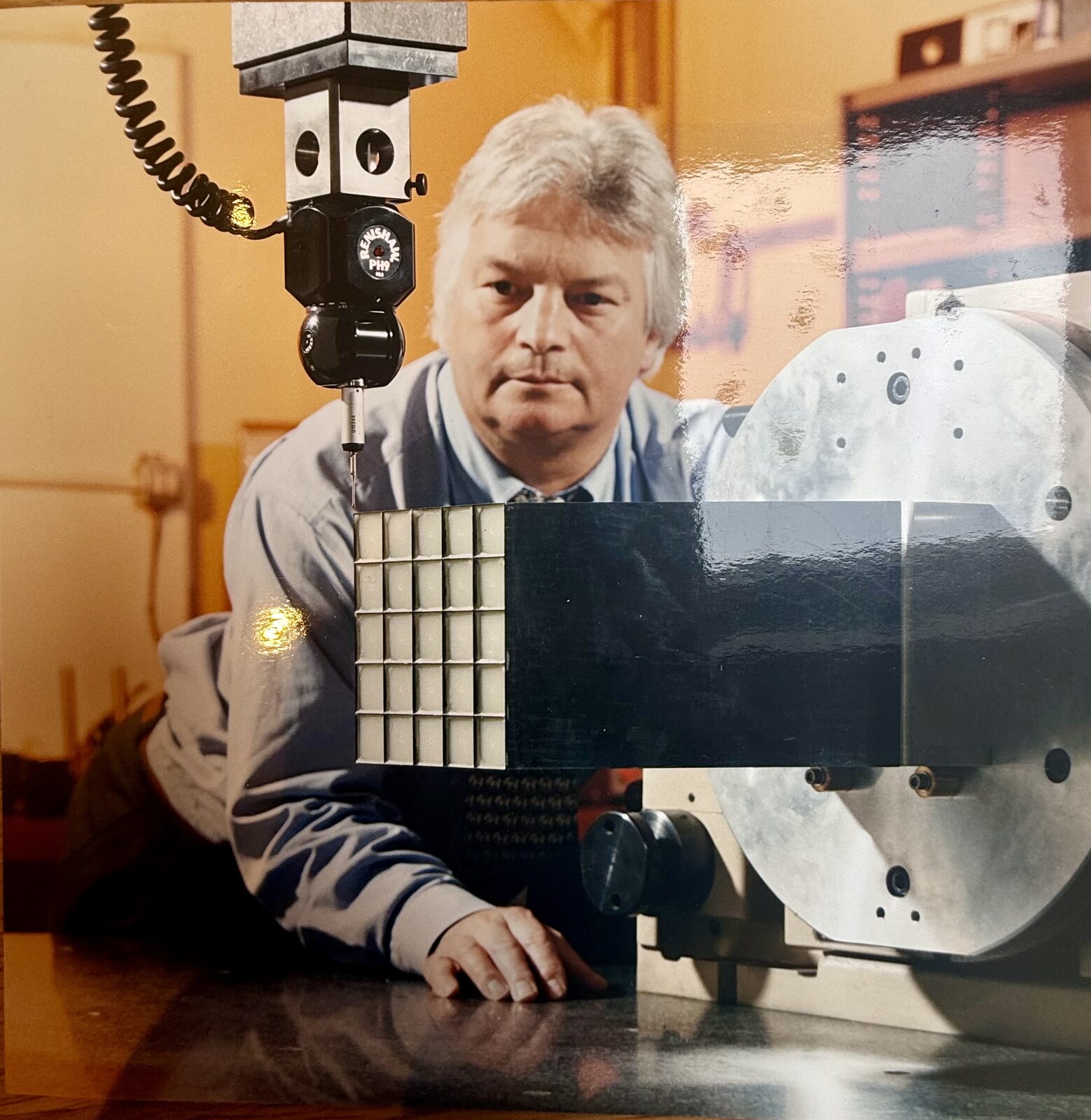
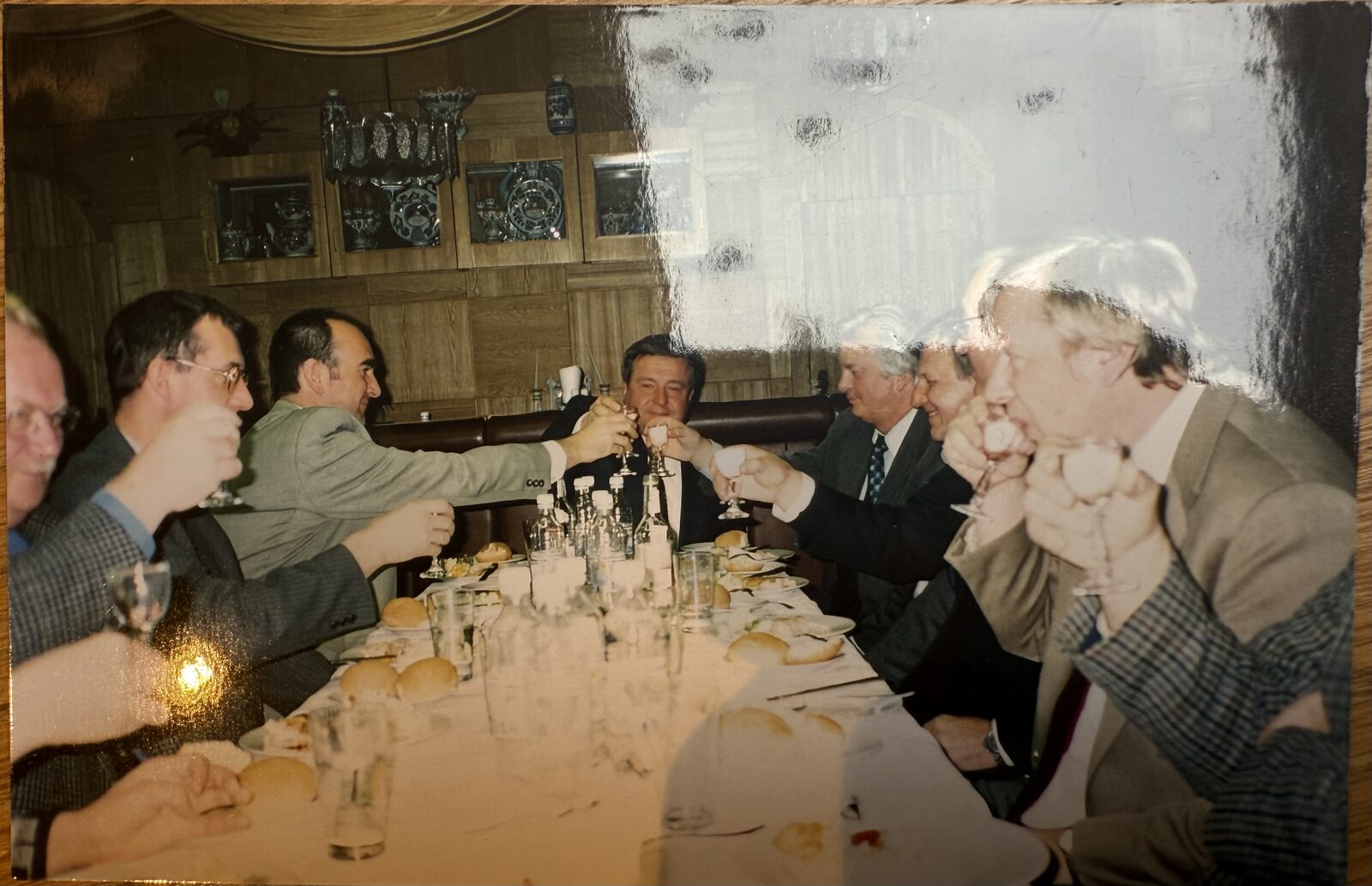
They said: “We'll have that.” It changed everything. Instead of tens of thousands of unique components, the entire end cap could be built from identical, interchangeable parts — cheaper to make, easier to assemble, and repairable: if one crystal failed you could simply swap in another. The crystals and pockets were manufactured in Russia; Brian designed the assembly trolleys, drew the read-out electronics cards, and wrote the assembly procedure. His team even built a test version from brass dummy crystals and deliberately crushed it to learn exactly how much load it could take.

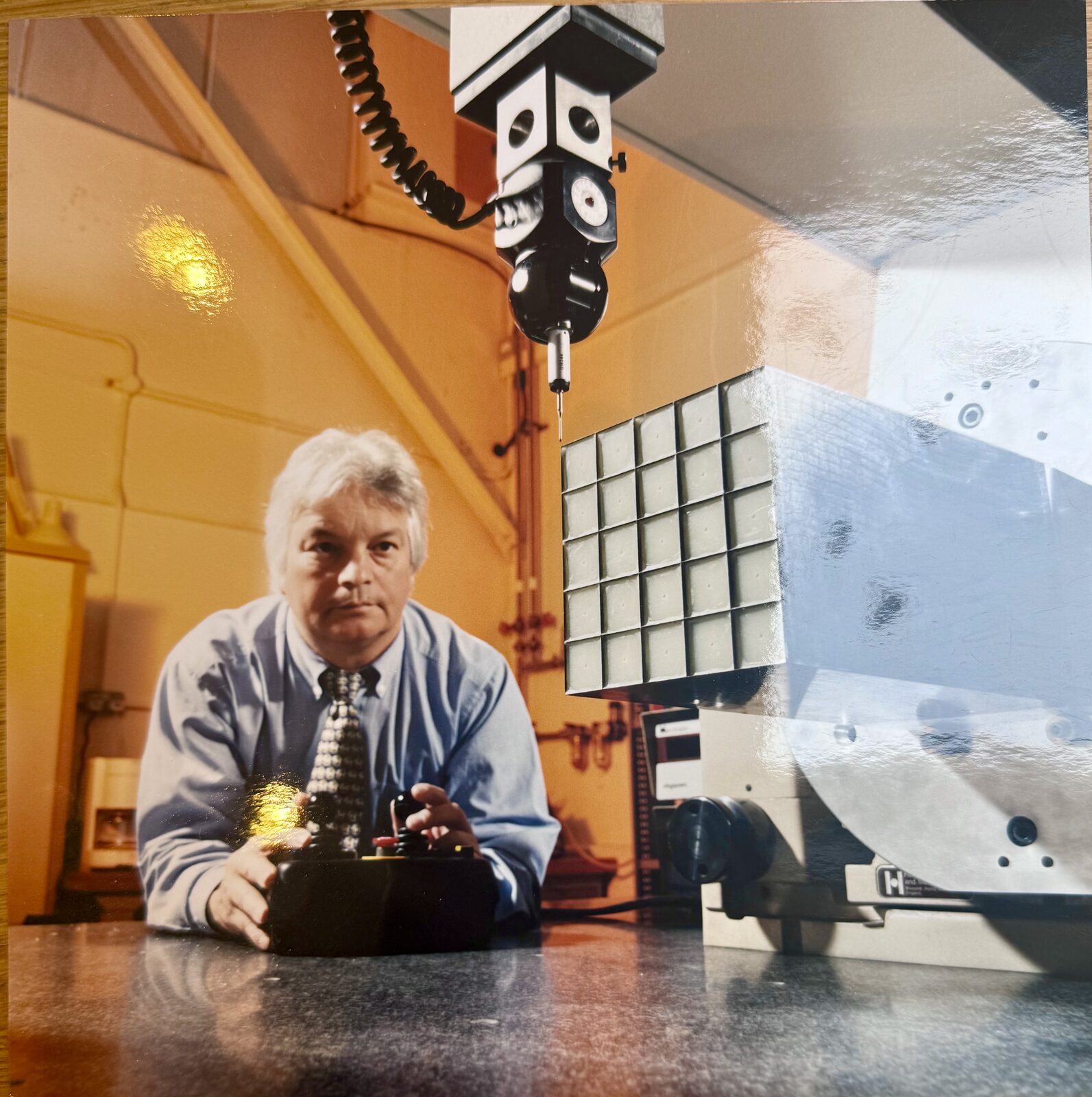
Brian Smith with a CMS ECAL crystal matrix
Brian with a CMS ECAL crystal matrix at Rutherford — the building block of the calorimeter.

From the archive: RAL contributor list (ATLAS SCT seminar) · the ATLAS detector brochure

05

The discovery

4 July 2012

By 2008 the LHC was switched on; by 2010 it was colliding protons in earnest. Two detectors — CMS and ATLAS — hunted independently, each blind to the other's results, so that any discovery would have to be confirmed twice over.

On 4 July 2012, both teams announced the same thing: a new particle, at the mass where the Higgs was expected, revealing itself partly through exactly those pairs of high-energy photons — the photons Brian's crystals were built to catch. The Standard Model was complete. The next year, Peter Higgs and François Englert received the Nobel Prize in Physics.

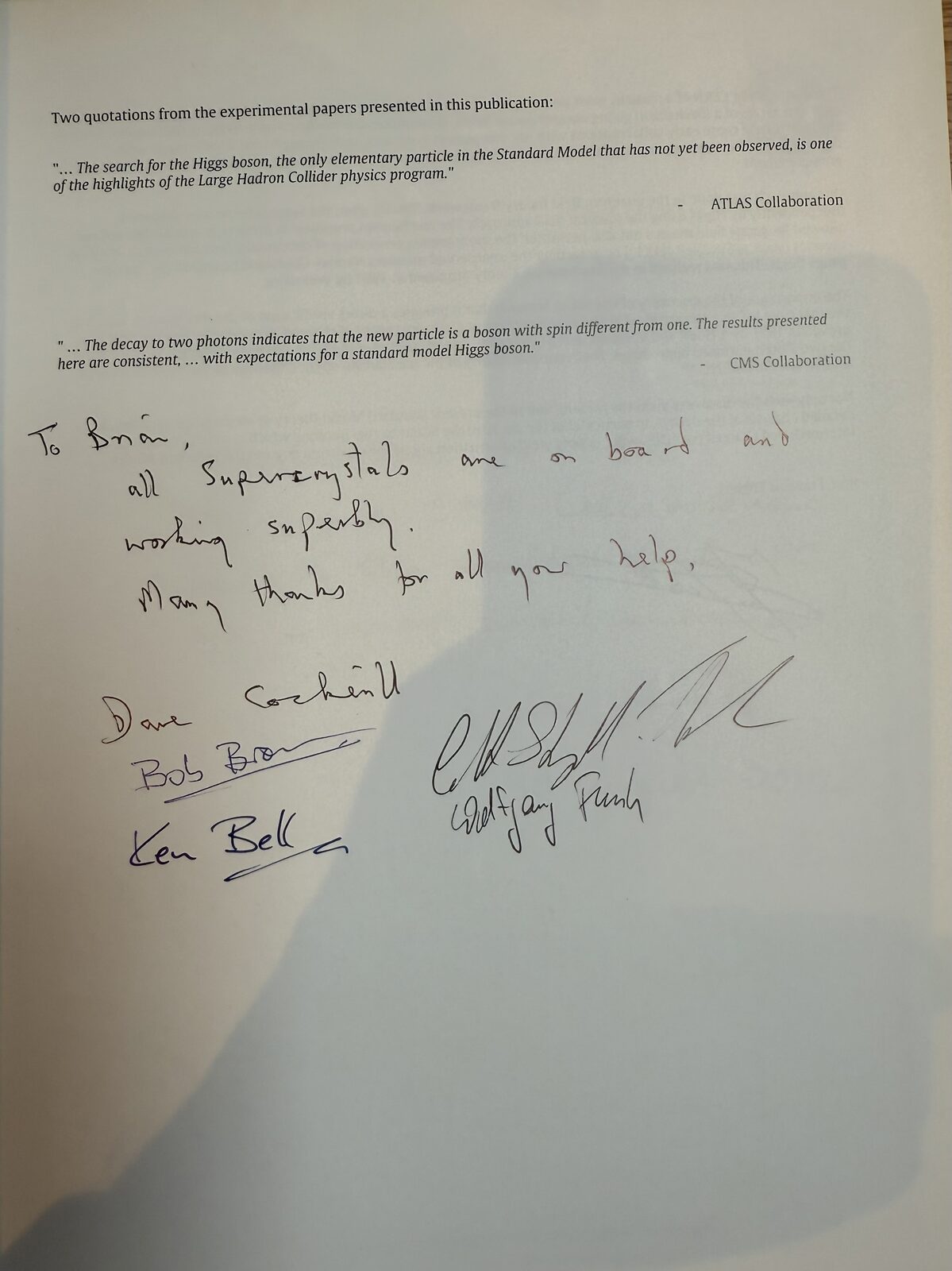
Brian's name doesn't appear in the headlines. But inside the published papers announcing the discovery, the CMS crystal team left him a handwritten note:

“To Brian — all Supercrystals are on board and working superbly. Many thanks for all your help.”

Asked whether he's responsible for the Higgs boson, his answer is immediate: “Yep — it's my fault!”

From the archive: the signed dedication · “First observations of a new particle…” (the published papers)

Signed dedication to Brian inside the Higgs publication
The signed dedication to Brian inside the Higgs-discovery publication.
06

What it means — and why it was worth it

Finding the Higgs confirmed that the invisible field giving particles their mass is real. It completed a theory that had taken half a century to test, and it opened the door to the next set of questions physicists are still chasing — about dark matter, and about whatever lies beyond the Standard Model.

Brian, characteristically, is more interested in the practical dividends than the abstract physics. The hunt for particles like the Higgs has driven real technology that touches ordinary life — the World Wide Web itself was invented at CERN to help physicists share data.

“Basically, they don't know exactly what they're finding — which is perfectly fine. But they get funding for it, and we get other developments. The web and all that. So we get spin-off technology come out of it.”

And running quietly through one of the biggest scientific stories of the century is a very simple idea, the same one that shaped his whole career: make it simple, make it repeatable, make it work. Make every crystal the same.

The road to the discovery

Where Brian's crystal work fits in the bigger story.

  1. 1964

    The idea

    Higgs, and Kibble, Hagen & Guralnik, propose the field that gives particles their mass.

  2. ~1998–2002

    Brian solves the end cap

    The universal, interchangeable crystal-and-alveola design — every crystal the same.

  3. ~2000s

    Crystals made in Russia

    Tens of thousands of lead-tungstate crystals produced and checked; assembly moves to CERN.

  4. 2008

    The LHC switches on

    The 27-km collider begins operation a hundred metres under the French–Swiss border.

  5. 2010–12

    The hunt

    CMS and ATLAS collide protons and search independently for the tell-tale signals.

  6. 4 Jul 2012

    Higgs boson found

    Both detectors announce a new particle — seen partly through the photon pairs Brian's crystals were built to catch.

  7. 2013

    Nobel Prize

    Peter Higgs and François Englert share the Nobel Prize in Physics.

Want to go deeper?

A few good explainers, for anyone who'd like more — we'll add to these as we find them.

“One moment you're going into outer space, looking at the Sun. And the next, exploring the tiny invisible particles that you can't see.”

From a door on a solar observatory to the crystals that caught the Higgs, Brian's work sits inside two of the great scientific instruments of our age.

← Back to Brian's full story