The dividends of curiosity

What it gave the world

Brian never claimed the discoveries. He was more interested in what fell out of the work along the way — the useful things that curiosity leaves behind. The two worlds he spent his life inside, particle physics and space science, turn out to be two of the greatest sources of the technology we now use without a second thought. ← back to the story

There's an old argument against funding science you can't explain to a taxpayer: what's the point of smashing atoms, or watching the Sun from a million miles away? Brian had heard it, and he had a quiet answer — the one an engineer gives, about the things that actually come out the other end.

“They don't know exactly what they're finding — which is perfectly fine. But they get funding for it, and we get other developments. The web and all that — this stuff. So we get spin-off technology come out of it. And of course, electronics have got smaller and better. A lot of this is driving that thing — same as the space race stuff and everything. It's how things move on.”

He's right, and it's worth spelling out just how right. Here are some of the everyday things that came out of the exact corners of science Brian worked in — a few of which passed close enough to touch his own hands.

01

The World Wide Web

Born at CERN, to help scientists share their work

The single most famous spin-off is the one Brian named himself. In 1989 a British scientist at CERN, Tim Berners-Lee, wrote a modest proposal for sharing information between physicists scattered across the world's institutes. By the end of 1990 he had built the first web browser, the first web server and the first web page. In April 1993, CERN put the software into the public domain — free for anyone, forever — and the modern internet as we know it began.

It was invented for exactly the community Brian belonged to: the particle physicists at CERN who needed to pass drawings, data and results back and forth between Geneva, Harwell and everywhere else. The web you're reading this on was built to help people do what Brian did for a living.

The NeXT computer at CERN that ran the world's first web server
The NeXT computer at CERN that became the world's first web server — kept with a hand-written label in red: “This machine is a server. DO NOT POWER IT DOWN!” Photo: Coolcaesar, CC BY-SA, via Wikimedia Commons
02

The touch screen

And it reached Brian's own lab in 1977

Long before smartphones, CERN engineers Bent Stumpe and Frank Beck built one of the world's first capacitive touch screens — the kind that senses your finger directly — to control the Super Proton Synchrotron. Stumpe sketched the idea in a handwritten note in 1972; by 1976 the new SPS control room was running on touch screens, some of which kept working for thirty years.

Here's the part that brings it home: by 1977, CERN was already selling those touch screens to other laboratories — and one of the first buyers was the Rutherford Laboratory in England, Brian's own workplace. The technology now in every pocket on Earth passed through the doors of the lab where he spent his career, while he was there.

A control room at CERN
Inside a CERN control room. Running the lab's accelerators from desks like these is exactly what drove CERN to build the first capacitive touch screens. © CERN, via Wikimedia Commons
03

From his crystals to cancer scanners

The detectors that catch particles also catch disease

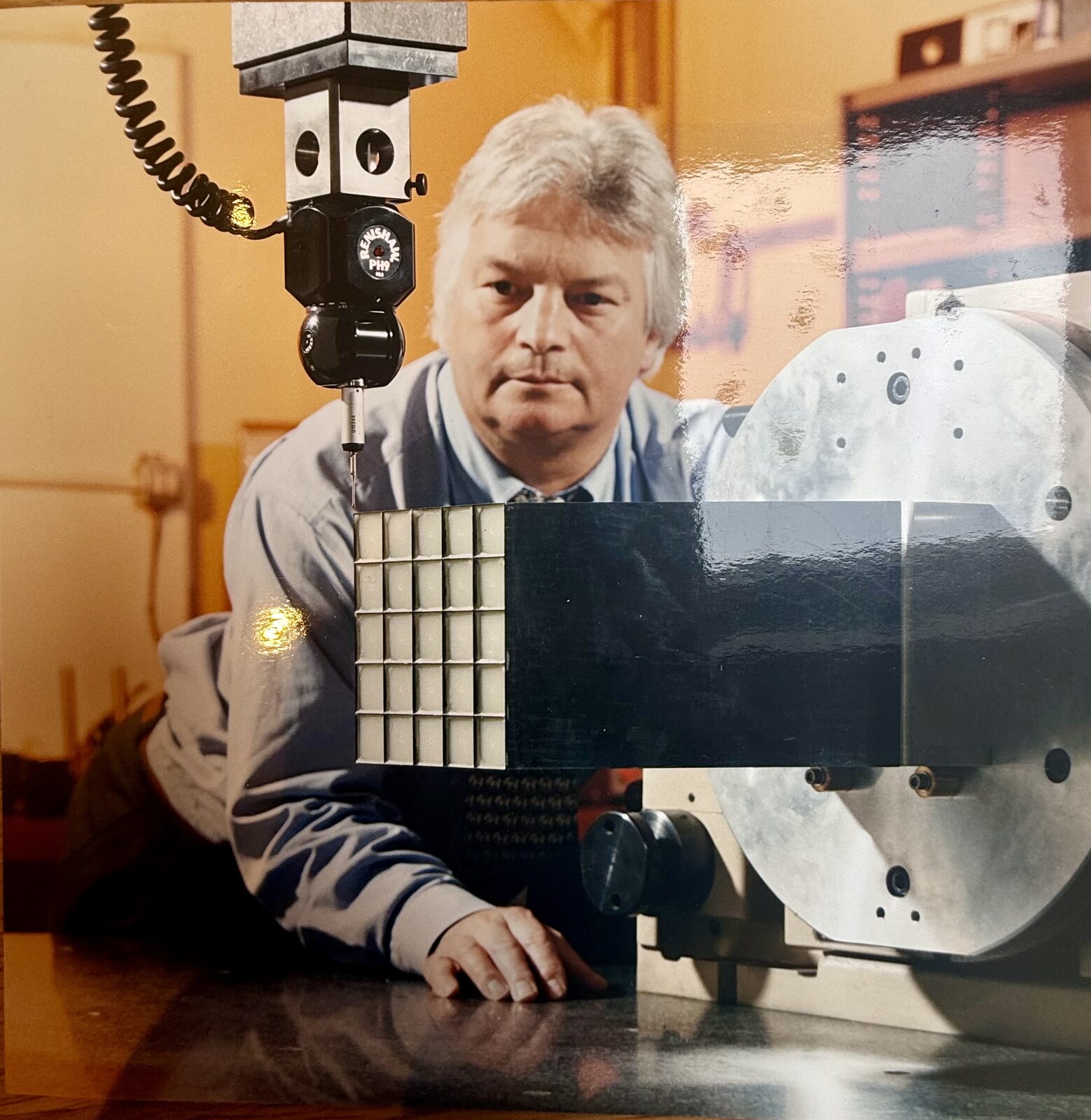
The crystals Brian helped build for CMS — dense, transparent blocks that flash with light when a particle strikes them — belong to the very same family of technology that powers the PET scanner, one of medicine's most important tools for finding cancer. A PET scan works by detecting exactly those tiny flashes of light, in exactly this kind of crystal.

It isn't a loose analogy. CERN's Crystal Clear Collaboration, formed in 1990 to develop detector crystals for the Large Hadron Collider, went on to develop crystals used in real PET devices — and the photo-sensors created for the CMS calorimeter were later adapted for breast- and prostate-cancer imaging. The wall of crystals Brian made simple and repeatable sits in the same lineage as the scanner that might one day find something in time to treat it.

Brian Smith with a CMS ECAL crystal matrix
Brian with a CMS crystal matrix at Rutherford — the same scintillating-crystal technology that underpins PET scanners.
04

From cold pumps to MRI

The deep cold that lets a magnet see inside you

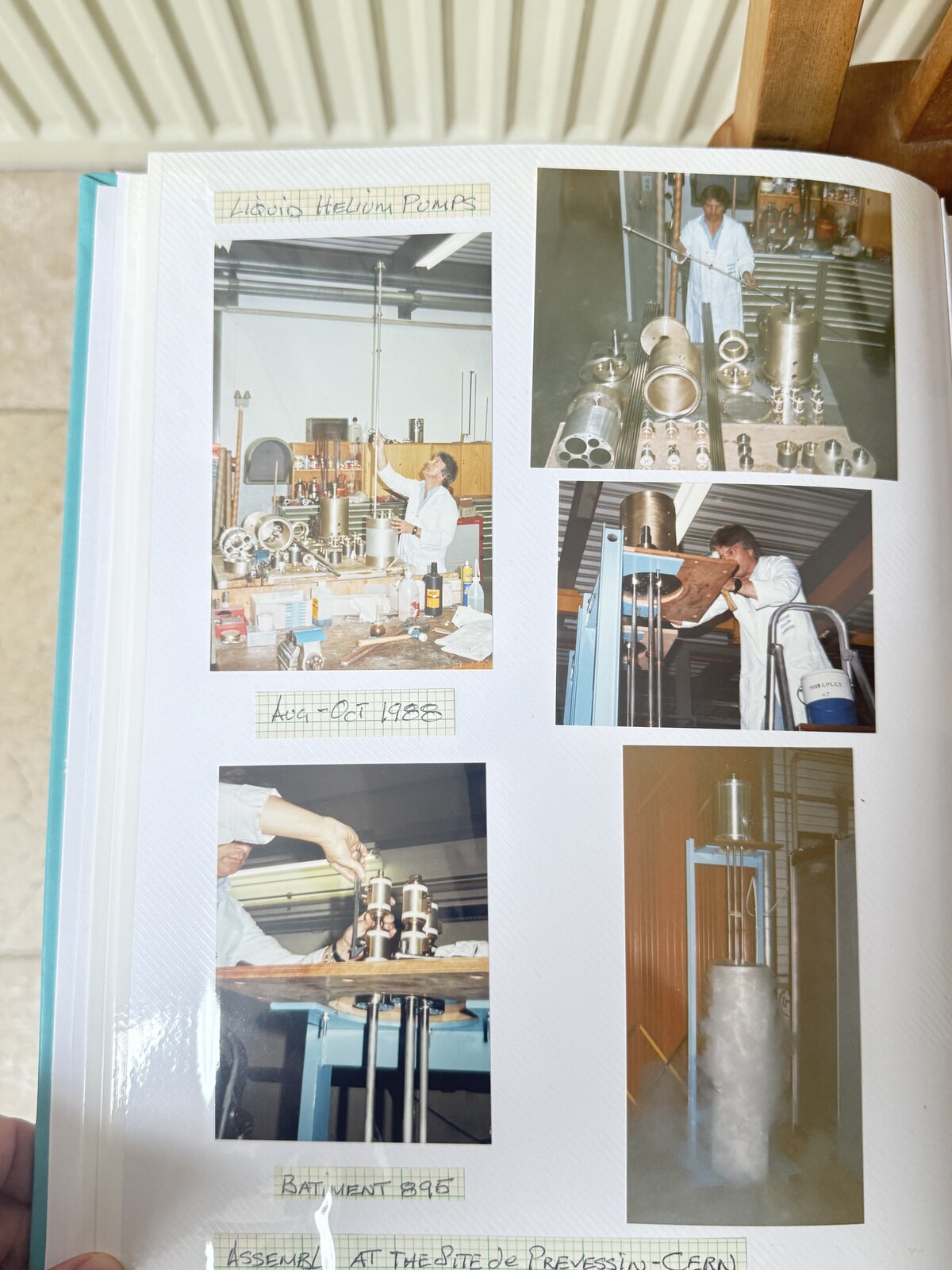
An MRI scanner works because a huge superconducting magnet is kept colder than deep space, so that electricity flows through it with no resistance at all. Keeping things that cold — cryogenics — is precisely the craft that particle accelerators depend on, and precisely the kind of work Brian did when he assembled liquid-helium pumps for cryogenic systems at CERN and beyond.

That expertise didn't stay underground. Much of Britain's cryogenic and superconducting-magnet industry grew up around Harwell and Oxfordshire — Brian's corner of England — where firms like Oxford Instruments turned accelerator know-how into the MRI scanners now found in hospitals worldwide. The cold he worked in helps other people see inside the human body without a single cut.

Brian with liquid-helium cryogenic pumps
Brian with liquid-helium pumps — the cryogenic craft that also cools the magnets inside every MRI scanner.
05

Watching the Sun, protecting the grid

The door he built opened an early-warning system for Earth

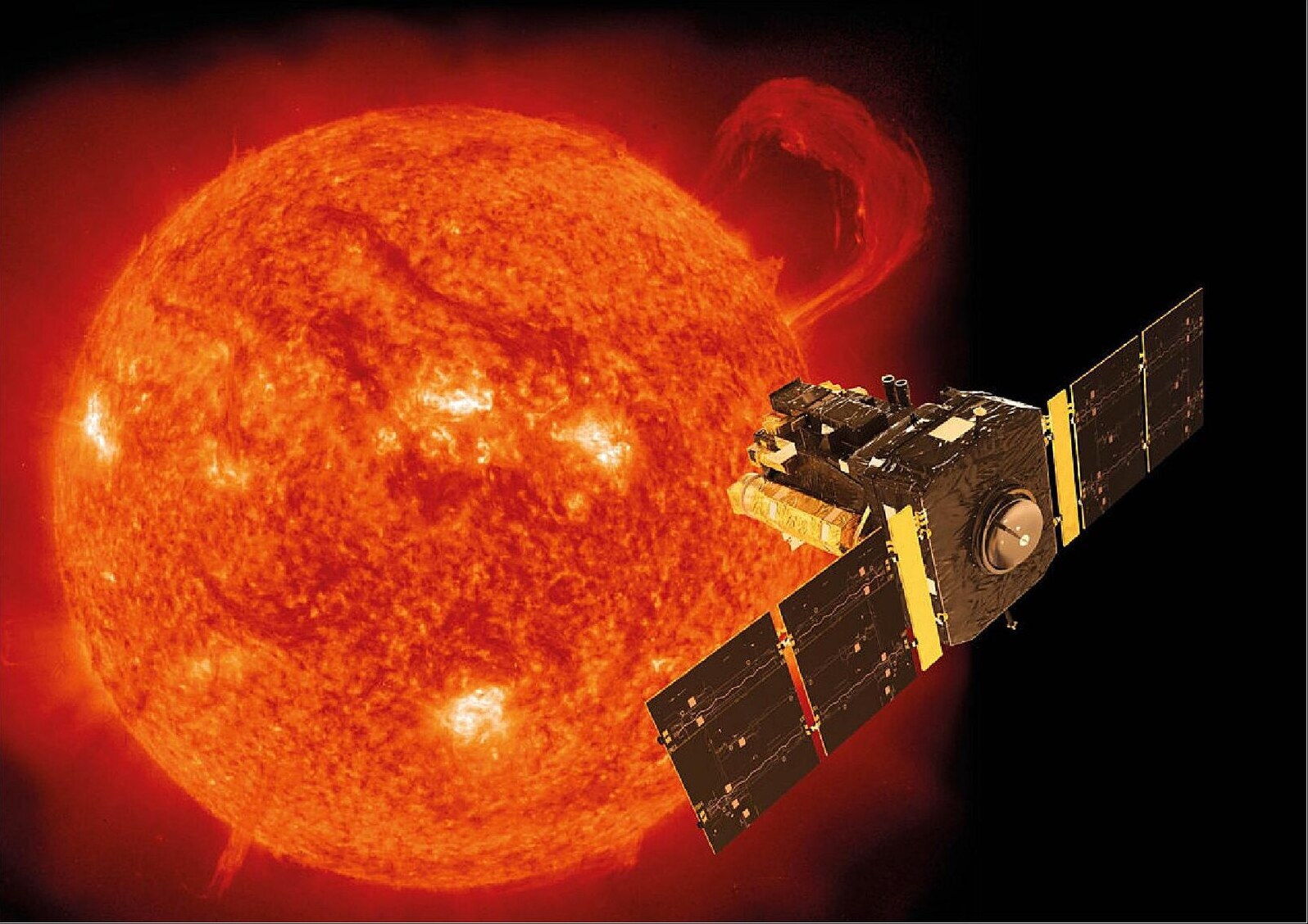
SOHO — the solar observatory whose instrument door Brian designed — did more than take beautiful pictures of the Sun. It became the first spacecraft to serve as an early-warning system for space weather, spotting the great eruptions of solar material that hurtle toward Earth and giving forecasters days of notice before they arrive.

That warning matters. A severe solar storm can knock out power grids, scramble GPS, damage satellites and endanger astronauts. Because instruments like the one behind Brian's door keep watch, grid and satellite operators can brace for the blow in advance. Thirty years on, SOHO is still a main source of the near-real-time solar data that space-weather forecasters rely on — a quiet guardian, opened by a quiet man.

The SOHO spacecraft watching the Sun
SOHO at its station between Earth and the Sun. Its solar warnings help protect power grids and satellites. ESA/NASA
06

Seeing through solid rock and metal

The same detectors, now X-raying the impossible

Cosmic rays rain down on the Earth every second, creating particles called muons — heavy cousins of the electron that pass straight through solid stone and metal, shedding a little energy as they go. Aim a particle detector — the same kind of technology built to catch particles at labs like CERN — at something massive, count the muons that make it through, and you can map what's hidden inside, without touching it. It's a free X-ray delivered by the cosmos.

In 2017, a team used exactly this to look inside the Great Pyramid of Giza and found a hidden void some thirty metres long above the Grand Gallery — the first major structure discovered inside it since the nineteenth century. The same technique has imaged the molten hearts of active volcanoes, and peered into the wrecked reactors at Fukushima to confirm where the melted nuclear fuel had settled — places no camera or person could ever reach.

The Great Pyramid of Giza
The Great Pyramid of Giza — particle detectors revealed a large hidden void inside it in 2017, without moving a single stone. Via Wikimedia Commons, CC BY-SA
07

The invisible plumbing of big data

When one computer isn't nearly enough

The experiments Brian's crystals fed produce a torrent of data — far more than any single computer centre on Earth could handle. So CERN and its partners built the Worldwide LHC Computing Grid, switched on in 2002, linking hundreds of computing centres across dozens of countries into one shared machine. It was a landmark in large-scale distributed computing — teaching the world how to store, move and crunch data at a scale that now underpins much of modern science and industry.

And a couple of stories, just for the fun of it

Not everything that comes out of big science is a gadget. Sometimes it's just a good tale — and Brian, who kept half an eye on this world long after he'd left it, had a fond ear for its stranger moments.

The night nothing could beat light — until, briefly, it could

“Some person messed up his maths one time, and he said he found a particle that's travelling faster than light. But he actually made a miscalculation. That was an Italian. And there was a bit of fuss about that.”

He's remembering a real episode. In 2011 an experiment called OPERA clocked neutrinos travelling from CERN to a laboratory deep under a mountain in Italy — and they seemed to arrive about sixty billionths of a second faster than light itself. If true, it would have overturned Einstein and physics as we knew it, and it filled newspapers and television bulletins around the world. (One physicist promised, live on air, to eat his shorts if it held up.) Months later the culprit turned out to be gloriously ordinary: a fibre-optic cable that wasn't screwed in quite tightly enough, throwing the timing off by exactly that sliver. Einstein was safe — and the shorts went uneaten.

Doorways to other universes

“They're talking about CERN now — it's opened up — to other universes. A little strange, perhaps… people come up with a lot of strange theories. Which, is fine.”

Brian is remembering a real moment. In 2015, when the Large Hadron Collider roared back to life at record energy, physicists floated a genuinely startling idea: that its collisions might briefly create tiny black holes — and that if they did, it would be a clue that our universe has extra dimensions folded invisibly into it, perhaps even parallel universes lying alongside our own. “CERN could open a door to another dimension,” ran the headlines. No black holes appeared and no doors opened — but the questions underneath are real ones that serious physicists still chase, through string theory and the “many-worlds” idea that reality itself branches with every quantum roll of the dice.

It's the sort of idea that leaps straight from the laboratory into the imagination — the multiverse has since become the engine of blockbuster films and countless stories. Brian spent his life at the practical end of all this, drawing the parts that made such questions askable in the first place, and he watched the wilder speculation with characteristic warmth: not everything has to be proven to be worth wondering about.

And then, with the universe's strangest questions swirling around the work he had done, he would bring it all gently back down to earth — a man who helped reach both the Sun and the inside of an atom, and never once thought himself a big deal: “I enjoyed it… It was fun.”

“It's how things move on.”

None of this belonged to Brian alone — each of these came from thousands of hands over many years, and he'd be the first to say so. But he was one of those hands, working inside the very enterprises that gave the world the web in your pocket, the scan that finds the tumour, and the warning that saves the grid. Simple things that worked, quietly adding up.

← Back to Brian's full story